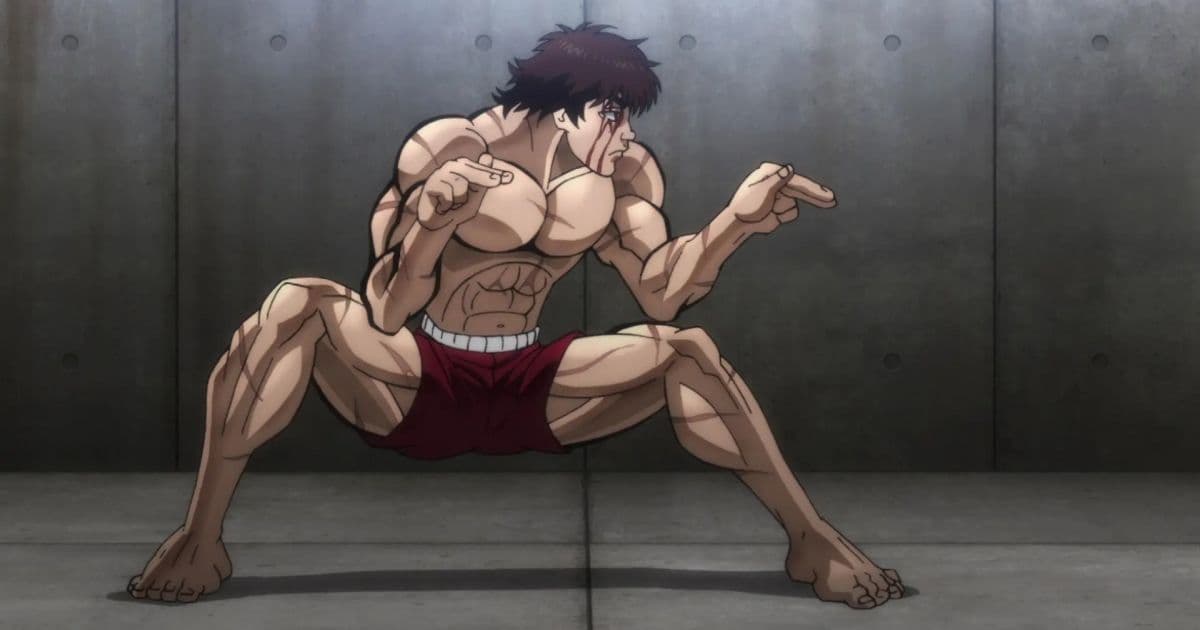

Baki Hanma stands 5'6" (168 cm) and weighs 166 lbs (75.5 kg). On paper, nothing special. In the ring, he's beaten opponents who outweigh him by 400 pounds, survived encounters with prehistoric warriors, and earned the title of strongest creature on earth's son. His father Yujiro Hanma is recognized as the strongest being alive, and Baki has trained his entire life to surpass him.
The Baki series shows a teenager who shadowboxes against a praying mantis to learn strike angles, who fights a Yasha ape at age 13 to test his limits, who runs until his feet bleed and then keeps running. The dedication is inhuman. The principles behind it translate to real training.
How Baki trains

The series documents specific training methods throughout Baki's development:
- Shadow boxing with full visualization (he fights opponents in his mind so vividly his body moves through the motions)
- Grip training from climbing and hanging (the helicopter scene in Season 1)
- Fighting wild animals for unpredictable resistance training
- Multi-day endurance runs across mountain terrain
- Intense bodyweight work with explosive movement
- Traditional martial arts drilling under Ando Retsu's guidance
You won't be wrestling wild boars or hanging from helicopters. But the core principles, explosive power, functional strength, combat conditioning, and mental intensity, form the foundation of this program.
The weekly split
Day 1: Explosive power
- Plyometric Push-ups: 4 sets of 10-15 reps
- Box Jumps: 5 sets of 8-10 reps
- Medicine Ball Slams: 4 sets of 12 reps
- Clapping Pull-ups: 3 sets of 6-8 reps
- Explosive Squats: 4 sets of 12 reps
- Sprint Intervals: 10 rounds of 30-second sprints with 30 seconds rest
Box jumps and plyometric push-ups come first while your nervous system is fresh. Baki's fighting style relies on explosive first strikes, and these movements train rate of force development. Reset fully between jump sets.
Day 2: Strength foundation
- Weighted Pull-ups: 5 sets of 8-10 reps
- Heavy Deadlifts: 5 sets of 5 reps
- Weighted Dips: 4 sets of 12 reps
- Bulgarian Split Squats: 4 sets of 12 reps per leg
- Farmer's Walks: 4 sets of 40 yards
- Hanging Leg Raises: 4 sets to failure
The deadlift is the anchor. Baki's grappling strength comes from hip hinge power and a rigid torso. Bulgarian split squats build the single-leg stability required for stance shifts during combat. Farmer's walks train the grip endurance he'd need for prolonged clinch fighting.
Day 3: Martial arts conditioning

- Shadow Boxing: 3 rounds of 5 minutes
- Heavy Bag Work: 5 rounds of 3 minutes
- Jump Rope: 15 minutes continuous
- Bodyweight Circuit (3 rounds):
- 50 Mountain Climbers
- 40 Burpees
- 30 Sprawls
- 20 Jump Squats
- 10 Handstand Push-ups
During shadow boxing, visualize an opponent. Baki's visualization training is supernatural in the manga (he can summon a praying mantis opponent and physically react to its attacks), but the principle applies: train your nervous system to execute combinations under imagined pressure. The circuit builds the work capacity to sustain output across multiple rounds.
Day 4: Endurance and recovery
- Long-Distance Run: 5-10 miles at moderate pace
- Mobility Work: 30 minutes
- Yoga or Dynamic Stretching: 45 minutes
- Light Technical Practice: 30 minutes
- Meditation: 20 minutes
Baki's endurance is inhuman (he runs from one end of Japan to the other in the manga), but his recovery habits matter more for programming. He takes rest seriously between fights. This day builds aerobic base while allowing the nervous system to recover from the week's explosive work.
Day 5: Grip and core
- Towel Pull-ups: 4 sets to failure
- Plate Pinches: 5 sets of 30 seconds each hand
- Dragon Flags: 4 sets of 6-8 reps
- Ab Wheel Rollouts: 4 sets to failure
- Dead Hangs: 3 sets to failure
- Farmer's Walks with Towels: 4 sets of 30 yards
Grip work is non-negotiable. Baki's ability to grab and control larger opponents depends on finger and forearm strength. Towel pull-ups and plate pinches stress grip in ways a standard barbell doesn't. Dragon flags build the anti-extension core strength required for grappling and strike absorption.
Signature moves and how to train them
Baki's Cockroach Tackle requires dropping low and shooting for a takedown with explosive hip drive. Box jumps train the hip extension, Bulgarian split squats build single-leg drive, and sprawls condition the reverse pattern. His Triceratops Fist relies on kinetic chain alignment from ground to fist — heavy bag work drills this, while core training ensures force transfers without leaking through a soft midsection. The Whip Strike uses a relaxed arm that snaps into tension at impact, a pattern you can train through medicine ball slams and shadow boxing with loose arms focused on the tension-at-impact moment.
Nutrition for Baki-level output

Baki eats constantly in the manga. His caloric demands are justified by his training volume. A realistic version of his nutrition approach:
- Protein: 1.8-2.2g per kg of bodyweight daily. Baki eats whole animals in the series; you can use standard protein sources
- Calories: 300-500 above maintenance to support training recovery
- Meal timing: 4-6 meals spread throughout the day, with larger meals around training
- Hydration: At least 1 gallon of water daily, more on conditioning days
- Pre-workout: Complex carbs 2-3 hours before training for sustained energy
- Post-workout: Simple carbs and protein within 30 minutes to initiate recovery
Programming considerations
This program runs five days per week at high intensity. If you're starting out, scale back:
- Cut sets by 30-40% across all days
- Take a full rest day between training days initially
- Master movement patterns before adding load or speed
- The plyometric work is demanding on joints; build into it gradually over 4-6 weeks
Baki's supernatural recovery doesn't apply to you. Sleep 7-9 hours. Take deload weeks every 4-6 weeks where you reduce volume by 50%. Listen to your body when it signals overreaching: persistent fatigue, decreased performance, and nagging joint pain mean you need more recovery.
The goal isn't replicating impossible feats. Baki visualizes his muscles as tiny warriors and activates 100% of his muscle fibers at will. You can't do that. What you can do is train consistently, progressively overload, and bring the same intensity to every session. Baki never half-reps. He never skips conditioning because he's tired. He never makes excuses. That mindset transfers even if the supernatural abilities don't.