
You went to bed at 1 a.m. after scrolling, the alarm hit at 6:30, and you're two coffees deep before your first meeting. So you buy blackout curtains. Then melatonin gummies. Then a sleep tracker that charges you a subscription to confirm you slept badly.
The variable nobody touches is what your eyes see in the first hour you're awake.
Your clock runs on a separate set of eyes
There's a cluster of neurons in your hypothalamus called the suprachiasmatic nucleus, and it sets the daily timing for core body temperature, cortisol, melatonin, and alertness. It needs an outside signal to stay locked to the real 24-hour day. That signal is light.
David Berson's lab at Brown worked out the wiring in 2002. They found retinal cells that fire in response to light on their own, even with all input from rods and cones blocked, and those cells run straight into the suprachiasmatic nucleus. They use a pigment called melanopsin, and they're tuned to short-wavelength blue, the wavelength that floods the sky after sunrise.
They're also slow. They want a lot of photons across a stretch of minutes, which is why flipping on a bright bathroom light does nothing for you.
Indoor light is closer to darkness than you think

Here's the number that reframes the whole thing.
In a 2013 Current Biology study, Kenneth Wright's team measured light exposure in adults going about a normal week, then sent them camping for a week with no flashlights or phones. Waking light exposure in the normal week averaged around 200 lux. Camping, they got roughly 10,000 lux around sunrise and sunset, and over 100,000 lux under midday sky.
After the camping week, melatonin onset moved earlier and the participants' biological night lined up with actual sunset and sunrise. The later chronotypes, the guys who naturally stay up, shifted the most.
A follow-up in 2017 found that a single weekend of camping produced about 69% of the shift a full week produced. Your clock responds fast once you give it a real signal.
How much morning sunlight you actually need
The practical target comes from a 2022 expert consensus published in PLOS Biology: a minimum of 250 lux melanopic EDI at eye level during the day. Melanopic EDI weights light by how much your melanopsin cells care about it, so it isn't the number a phone light meter shows you. In practice, ordinary indoor lighting rarely reaches it and standing outside clears it without effort.
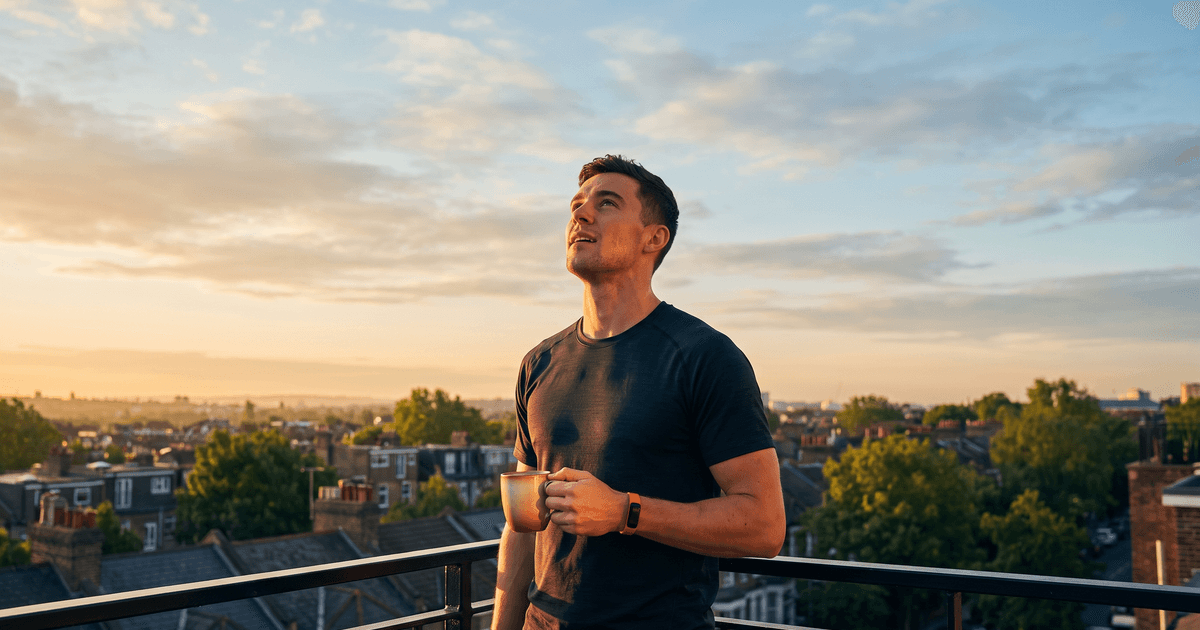
Which turns into a simple rule. Get outside within an hour of waking, give it ten minutes on a clear morning and longer under heavy cloud, and let your eyes take in a wide view of open sky instead of the pavement.
Timing carries as much weight as the dose. The phase response curve mapped by Khalsa and colleagues in 2003 shows that light landing after your core body temperature minimum, which falls roughly a couple of hours before your habitual wake time, pulls your clock earlier. The same light in the hours before bed pushes it later. Morning is the window where the shift you want is the shift you get.
Andrew Huberman builds his entire day around this, with 5 to 10 minutes outside at 5 a.m. before anything else. His wake-up time is optional. What matters is that the light lands early relative to your own wake time, whenever that happens to be.
What breaks it
Sunglasses. Skip them for that first block outside. Prescription glasses and contacts are fine, since they pass visible light.
Windows. Glass plus a narrow slice of visible sky costs you most of the intensity. Sitting by a window beats sitting in a hallway. Neither one is stepping outside.
Overcast. Cloud cuts the intensity and still leaves you far above anything indoors. Add time rather than writing the day off.
And never look directly at the sun. You want open sky in your field of view, not the disc.
The evening half of the equation

Morning light does very little if you undo it at 11 p.m. The same consensus paper recommends staying under 10 lux melanopic EDI in the three hours before bed, and under 1 lux while you're actually asleep.
That's where most people lose. Overhead lights, a TV across the room, and a phone at arm's length in a dark bedroom all push your clock in the direction you spent the morning fighting.
What actually changes
Worth being honest about the effect size. In a small trial of 12 students, 1.5 hours of 1000-lux morning light across five workdays produced earlier sleep onset, shorter time to fall asleep, better sleep efficiency, and lower morning sleepiness compared to a standard 300-lux office. Twelve people is twelve people, and the camping studies are small too.
So take it for what it is: free, low-risk, mechanistically well understood, and worth two weeks of consistency before you decide it did nothing for you.
Where this lands for training

Maximal output tends to peak in the late afternoon and early evening, tracking core body temperature, which is why your 5 p.m. session usually feels stronger than a 6 a.m. one.
Morning light works on the rhythm underneath that peak. Anchor the rhythm and your afternoon session lands in roughly the same place every day rather than drifting around with your sleep schedule.
If you train early because that's the only slot you have, there's a separate finding worth knowing: the morning strength deficit gets blunted by consistently training in the morning. Your body adapts to the slot you keep showing up in. Morning light supports that adaptation by locking down the wake time you're training against.