
You slept six hours, felt wired at 1 a.m. scrolling your phone, then dragged yourself through a bench session where every rep felt heavier than it should. Recovery didn't happen because sleep didn't happen. And no pre-workout fixes a nervous system that never got to power down.
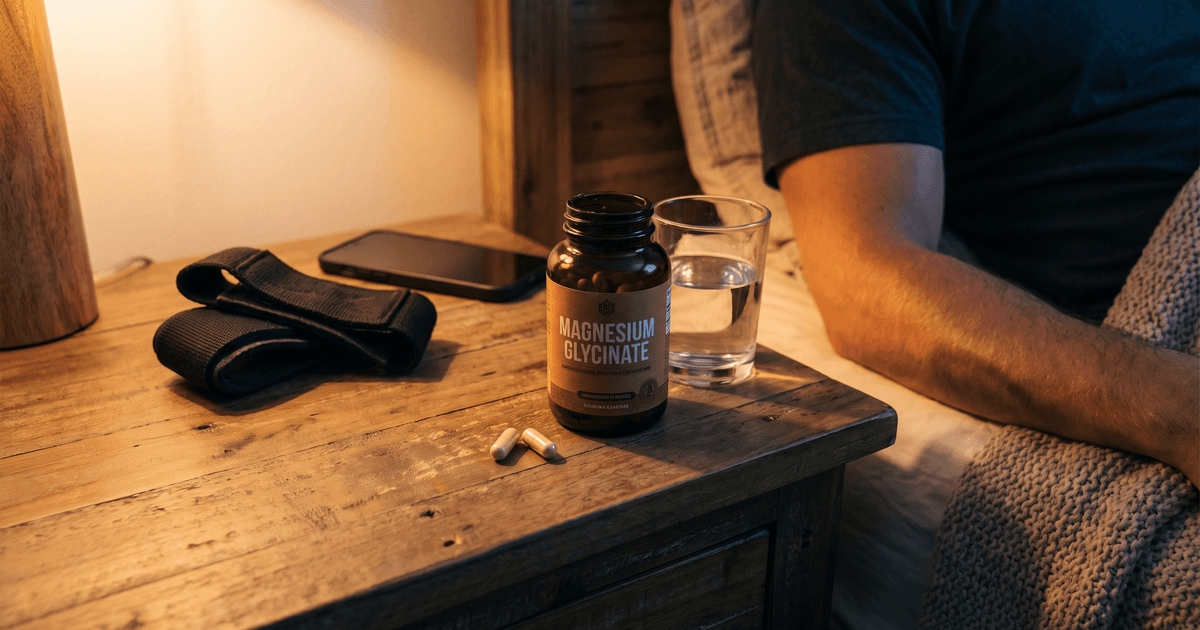
Magnesium keeps showing up in the sleep conversation for a reason. It's a real mineral doing real work in your brain and muscles. The catch is that most magnesium supplements are the wrong form, the wrong dose, or taken at the wrong time. Magnesium glycinate solves the form problem, and it's the one worth putting in your stack if sleep and recovery are the goal.
Why magnesium touches sleep at all

Magnesium is a cofactor in more than 300 enzyme systems that run everything from protein synthesis to nerve function. Two of those jobs matter directly for winding down at night.
It calms the excitatory side of your brain. Magnesium sits in the pore of the NMDA receptor, one of the main drivers of neural excitement. When magnesium occupies that spot, it dampens the signal, which is part of how your nervous system shifts out of "go" mode. A 2025 review in Nature and Science of Sleep describes magnesium acting as both an NMDA receptor antagonist and a GABA receptor agonist, a dual action that tunes down neural excitability and supports slow-wave sleep, the deep phase where physical recovery mostly happens.
It relaxes muscle. By blocking calcium influx into muscle cells, magnesium makes muscles more willing to release tension. If you lift hard, you know the feeling of lying down with your legs still buzzing. That's partly a calcium-magnesium balance problem.
Here's the part that makes this practical. A lot of lifters are running low. NHANES intake data cited by the NIH Office of Dietary Supplements shows a large share of Americans consume less magnesium than the recommended amount, and hard training burns through it faster through sweat and increased metabolic demand. You can be deficient enough to sleep worse without being deficient enough to show symptoms your doctor would flag.
What the research actually shows
The most cited trial here is Abbasi and colleagues, 2012, a double-blind, placebo-controlled study in 46 older adults with primary insomnia. The magnesium group took 500 mg daily for eight weeks. Compared to placebo, they showed improvements in sleep efficiency, sleep time, and sleep onset, along with higher serum melatonin and lower cortisol.
Two honest caveats. The subjects were elderly, and the dose was elemental magnesium, not the label weight of a glycinate capsule (more on that distinction below). This isn't proof that a 25-year-old who already sleeps fine will sleep better on magnesium. It's decent evidence that if you're low and your sleep is rough, correcting the deficiency helps.
That's the right frame for magnesium generally. Think of it as a deficiency corrector. If your levels are already solid, expect a smaller effect than the guy who's been running on gas-station snacks and four hours a night.
Why glycinate specifically

Not all magnesium is absorbed the same way, and this is where most people waste their money. Magnesium oxide, the cheap form stuffed into bargain multivitamins, is poorly absorbed and better known as a laxative than a sleep aid. The NIH notes that more soluble forms are absorbed more completely than oxide.
Glycinate is magnesium bound to glycine, an amino acid. That chelated structure absorbs well and, crucially for a bedtime supplement, tends to be gentle on the gut instead of sending you to the bathroom. Glycine itself is mildly calming, so the pairing works with the sleep goal rather than against it.
If your only exposure to magnesium was a cheap oxide pill that did nothing but upset your stomach, that's the form, not the mineral.
Form, dose, and timing

Form. Magnesium glycinate (sometimes labeled bisglycinate) for sleep and recovery. Citrate is a fine budget alternative but more likely to loosen your stool. Skip oxide for this purpose.
Dose. Read the elemental magnesium number on the label. A capsule labeled "1,000 mg magnesium glycinate" might only deliver around 100 to 140 mg of elemental magnesium, because the glycine makes up most of that weight. Aim for roughly 200 to 400 mg of elemental magnesium in the evening.
Stay aware of the ceiling. The tolerable upper intake level for supplemental magnesium is 350 mg per day for adults, and that limit is about supplements specifically, separate from what you get in food. The main sign you've gone too high is loose stools. Start on the lower end, see how you respond, and adjust.
For context, the RDA is 400 to 420 mg for adult men and 310 to 320 mg for women, counting food plus supplements. Most of your magnesium should still come from food. Pumpkin seeds, spinach, black beans, almonds, and dark chocolate are all dense sources. Supplementing is for closing the gap, not replacing the plate.
Timing. Take it 30 to 60 minutes before bed. That lines up the absorption window with when you're trying to power down. If you also want the muscle-relaxation benefit after a brutal leg day, an evening dose covers both the sleep and the recovery angle in one shot.
Where it fits in a recovery stack
Magnesium glycinate won't out-train a bad schedule. Doom-scrolling at midnight, three pre-workouts a day, and eating your last meal at 11 p.m. will beat any supplement. Fix the obvious stuff first: consistent sleep and wake times, less caffeine after mid-afternoon, a dark cool room.
Once the basics are in place, magnesium glycinate earns its spot. It's cheap, well tolerated, backed by real mechanisms, and it targets the exact overlap you care about as a lifter: falling asleep faster, sleeping deeper through the slow-wave phase where tissue repairs, and waking up with muscles that aren't still holding tension from yesterday's session.
Train hard, then actually let your body cash in the recovery. Magnesium helps you close that loop.