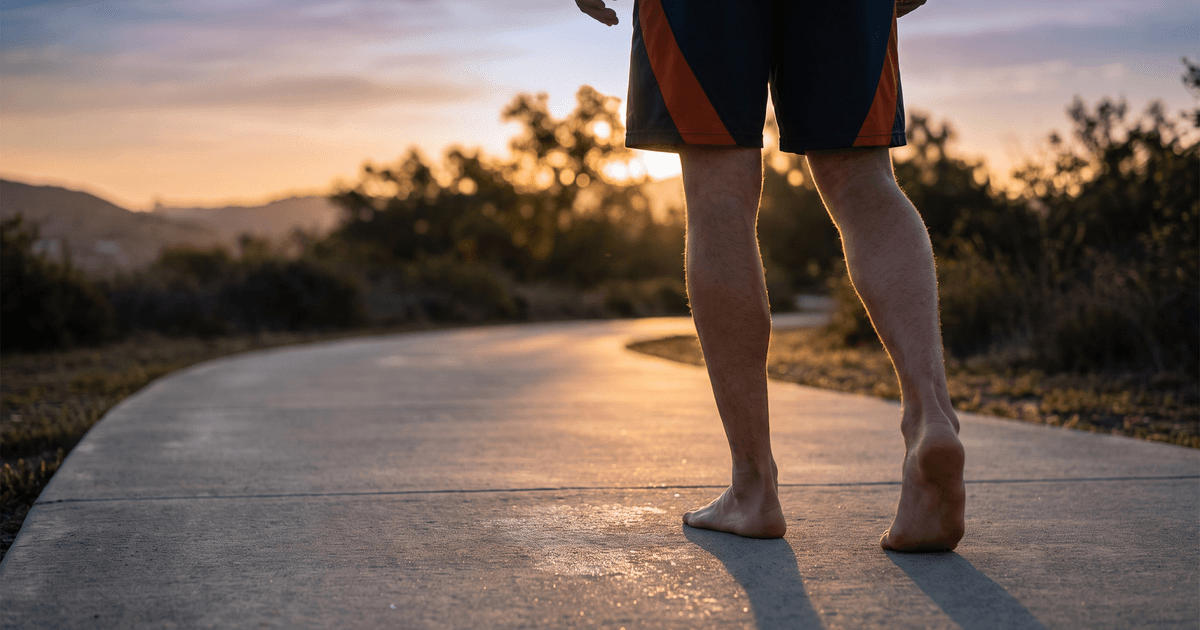

Film yourself walking toward a camera and play it back at quarter speed. Most people see the same things inside three steps: toes splayed outward, heel slamming down, the inside of the ankle sinking as weight arrives, knee drifting toward the midline. It's the movement you repeat all day, every day, and the only one you've never programmed.
GOATA came out of that footage. The system was developed in 2012 by Gary Scheffler and former NFL quarterback Ricky Stanzi, refining patterns originally identified by José Boesch, out of what the official site describes as "thousands of hours of slow-motion video analysis." The sampling is the part worth knowing. They pulled from four groups: crawling infants, habitually barefoot populations, elite athletes like Michael Jordan and Usain Bolt, and centenarian track athletes like Ida Keeling and Julia Hawkins. Then they looked for what all four had in common. That overlap is what they trademarked as the Global Laws.
Here's their walking model, and the drills they use to teach it.
Feet close, feet straight, eggshell heels

Fix the stance before you take a step. GOATA's entire entry point compresses into one line: "Instead of feet wide, go feet close. Instead of feet crooked, go feet straight. Instead of heavy heels, we're going to get lighter in the heels."
Feet close means roughly a fist's width between them. Narrower than the shoulder-width default you've been standing in since your first squat cue. Feet straight means the second toe aims down your line of travel, heel bone tucked almost directly behind the ball of the foot. And eggshell heels is the one that reorganizes everything above it: load the heel like it's an eggshell you'd rather not crack.
Stand that way for sixty seconds. It reads as tall and slightly foreign, like your weight moved forward without you leaning.
One coaching note on straight: skeletal torsion varies enormously between people, so work toward a straight second toe from wherever yours currently sits and let the knee stay honest while you do it. Forcing the foot straight by twisting above it defeats the point.
Load the cuboid
GOATA's central foot concept is IABH, inside ankle bone high. The medial ankle bone rides higher than the lateral one, the arch holds its shape under load, and the foot becomes a rigid platform instead of a surface that folds. The failure state is IABL, inside ankle bone low.
They describe the foot as a half-dome: "arches shouldn't collapse. They should actually get stronger as pressure gets applied to them."
Their tripod differs from the one you've been taught. Standard coaching puts it at heel, first metatarsal, fifth metatarsal. GOATA replaces the heel with the cuboid, giving you cuboid, pinky toe pad, big toe pad, because in their model "the heel bone is not a loading zone." The heel's job is to stay stable and quiet as an attachment point for the Achilles.
This stops well short of rolling onto the outer edge of your foot. GOATA abandoned the outside-edge cue because people kept rolling onto the fifth metatarsal. Their correction: "it's not supination of the foot. It's always multiplanar." You're on the underside of the foot, weight through the cuboid, and the big toe pad stays down the whole time.
The knee opens

As pressure moves up the column, the shin rotates and the kneecap points outward. GOATA puts the target at roughly 22.5 degrees off the line of a straight second toe, which in practice means the kneecap tracks outside the pinky toe.
"Notice how my knee opened. It went outside of my pinky toe. What we don't want to see is a knee stay over the second toe, or even worse, go inside the big toe."
The foot holds still while the limb rotates on top of it, which is why GOATA calls the foot a platform and the leg a joystick.
Tail back, crown forward
For the torso, GOATA's cue is that the tail drives the crown. The pelvis reaches back, the crown of the head reaches forward, and the hip sits behind the ribs rather than tucked underneath them. They call the tucked-under version compression, and it's the posture eight hours of sitting installs by default.
The execution is simpler than the theory: "feel like the torso is long and stretched out, feel like the tail is reaching for one end of the room, the crown of the head is reaching for the other."
Head position matters more than you'd expect. Their cue is "where the head goes, the pressure flows," which means the head shifts slightly into whichever leg is loaded. In their film breakdowns, the nose sits over the second toe of the loaded foot. Eyes up and down the line you're traveling.
Big toe up and in
The cues so far govern how you arrive. This one governs how you leave.
When the foot exits the ground, the big toe travels up and in while the heel moves away from the body. The default exit sends the big toe down and out, which is what has so many people finishing a step by rolling across the inside of the foot. "When I leave the ground, my big toe goes in and up. I don't want to leave the ground and my big toe goes down and out."
GOATA frames the full cycle as four phases: bow, corner, release, reset. Bow is the loading expansion, down and back and out. Corner is the contraction back toward the midline, up and around and in. Running all three planes at once is what they mean by the spiral.
The drills

Four of them, in order. Each takes a couple of minutes.
Rock your feet. Stand in the corrected stance. Drive pressure into the center of your heel bone, then shift out of it until the load arrives at the outside midfoot. Go back and forth, shading the territory between heel and cuboid until you can find the cuboid on demand.
The waddle. Same stance, staying out of the heel, lift one heel at a time. Watch in a mirror and confirm the kneecap tracks outside the pinky toe as the shin rotates. GOATA compares the shin to a windshield wiper.
Load and transfer. Waddle side to side like a penguin. Head moves into the loaded column, the loaded side spirals outward, the unloaded side spirals inward, and the foot holds its tripod throughout.
The march. Lift one leg fully and drive toes in, heel away. Alternate deliberately between big toe up and in, then big toe down and out, so you can feel the difference. Then march in place at your normal walking cadence. As speed picks up, cut the checklist down to three things: feet close, feet straight, heel away.
From there it becomes a step drill. March forward and back, landing second toe straight, leaving big toe up and in. GOATA suggests thinking of it as stepping on the four corners of a rectangle rather than walking a tightrope, which keeps you out of the narrow crossover pattern.
Film it at quarter speed again after a week. Watch the inside ankle bone on contact, watch where the kneecap points, and watch what the big toe does on the way out. Those three markers tell you whether the pattern is taking.