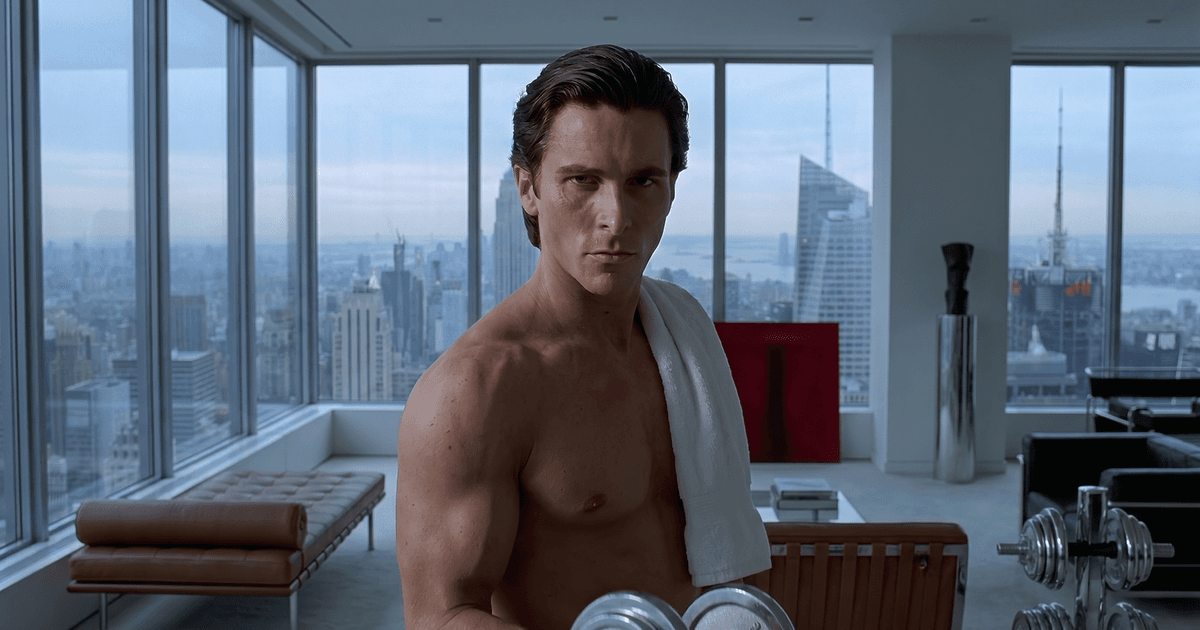

Patrick Bateman stands at 6'0" (183 cm) and maintains a lean 175 pounds of muscle through fanatical dedication. As a 27-year-old investment banker at Pierce & Pierce, he represents 1980s Wall Street excess taken to its logical extreme, and his approach to fitness reflects that obsession. We see glimpses of this in American Psycho: the morning routine includes 1,000 stomach crunches before he even leaves the apartment.
Christian Bale built his performance around this physical obsession. The actor achieved a similarly lean, defined physique for the role, foreshadowing the extreme body transformations that would define his career, from dropping to 120 pounds for The Machinist to bulking up for Batman Begins. The body is the foundation of Bateman's entire character -- the thing every other obsession builds on top of.
The philosophy

Bateman's training blends 1980s bodybuilding culture with the high-intensity work ethic that Wall Street demanded of its young bankers. He treats his body like a project to be optimized, another status symbol alongside the Valentino suits and the business cards with raised lettering on Silian Grail.
The core principles:
- High-volume training for visible muscle definition
- Scheduled workout times that never move
- Obsessive attention to form and technique
- Strength work combined with cardiovascular conditioning
- Morning calisthenics as both physical and mental ritual
He crafts his body with the same precision he applies to his skincare routine or the font selection on his business card. Every set has a purpose. Every rep serves the aesthetic.
Weekly workout split
Day 1: chest and shoulders
- Bench Press: 4 sets x 8-12 reps
- Incline Dumbbell Press: 4 sets x 10-12 reps
- Cable Flyes: 3 sets x 12-15 reps
- Military Press: 4 sets x 8-12 reps
- Lateral Raises: 3 sets x 12-15 reps
- Morning Crunches: 1,000 reps (broken into sets)
Day 2: back and biceps
- Wide-Grip Pull-ups: 4 sets x 8-12 reps
- Bent-Over Rows: 4 sets x 10-12 reps
- Lat Pulldowns: 3 sets x 12-15 reps
- Barbell Curls: 4 sets x 8-12 reps
- Hammer Curls: 3 sets x 12-15 reps
- Morning Crunches: 1,000 reps
Day 3: legs
- Squats: 4 sets x 8-12 reps
- Leg Press: 4 sets x 10-12 reps
- Leg Extensions: 3 sets x 12-15 reps
- Hamstring Curls: 3 sets x 12-15 reps
- Calf Raises: 4 sets x 15-20 reps
- Morning Crunches: 1,000 reps
Day 4: arms and abs
- Close-Grip Bench Press: 4 sets x 8-12 reps
- Skull Crushers: 3 sets x 12-15 reps
- Preacher Curls: 3 sets x 12-15 reps
- Cable Pushdowns: 3 sets x 12-15 reps
- Weighted Decline Crunches: 4 sets x 15-20 reps
- Morning Crunches: 1,000 reps
Rest days
- 30 minutes on the treadmill at low intensity
- Morning Crunches: 1,000 reps
- Focus shifts to the skincare routine and recovery
How Christian Bale actually prepared for the role

Bale worked with a trainer and followed a strict diet to achieve Bateman's physique. In interviews, he described the preparation as grueling but necessary to capture the character's vanity. Bale ate clean, high-protein meals and cut his body fat to around 6-8% to achieve the shredded look visible in the apartment scene where Bateman does his morning crunches shirtless.
What made this preparation distinctive was Bale's attention to how Bateman would move. He trained for the body of someone who spent hours staring at himself in mirrors, someone who prioritized aesthetics above function. The result is a physique that looks almost artificial in its perfection, fitting for a character whose entire identity is surface-level presentation.
Bale has spoken about how maintaining that level of leanness affected his mood and energy, noting that extreme dieting creates a specific kind of irritability that fed into Bateman's barely-contained rage. The physical transformation shaped the performance directly -- the hunger, the rigidity, the constant self-monitoring all bled into how he played the character.
The 1980s Wall Street aesthetic

Bateman's physique represents a specific archetype: the 1980s power player. The era belonged to bodybuilding, to Arnold Schwarzenegger on magazine covers, to cocaine and gym memberships and leather briefcases.
The ideal was lean, defined, and showy. Bateman trains for the way his body looks in a suit, the way his shoulders fill out his Valentino, the way his abs photograph. His workouts prioritize the mirror muscles: chest, shoulders, arms. He does his 1,000 crunches because a flat stomach signifies discipline to the world. Legs exist but receive less attention because they're hidden under pleated trousers.
This matches the training culture of the 1980s, when bodybuilding splits dominated gym floors and the bench press was king. Bateman's program would have fit right in at any upscale Manhattan gym in 1987, surrounded by other bankers and traders working through nearly identical routines between deal-making calls.
Diet and lifestyle
Maintaining 175 pounds at 6'0" with visible abs requires strict nutrition. Bateman's approach mirrors his personality: controlled, precise, ritualistic.
From what we see in the film:
- Breakfast: Fresh squeezed orange juice, Captain Crunch cereal (a surprising choice that suggests some flexibility beneath the rigidity)
- Pre-workout: Sports drink for electrolytes
- Post-workout: High-protein shake
- Dinner: High-protein meals at restaurants like Dorsia, Texarkana, and Arcadia, ordered with obsessive specificity
His habits extend beyond food. He keeps alcohol consumption low except when social situations demand it. He hydrates constantly. The skincare routine alone takes longer than most people's entire morning. Every input is managed because every output matters.
Training psychology

Bateman's relationship with exercise reveals something about his character beyond the physical results. The 1,000 daily crunches are a ritual, a form of control in a life that feels increasingly out of control beneath the surface.
His workouts never vary. The same exercises, the same rep ranges, the same obsessive form. This rigidity mirrors his approach to restaurants, to music, to business cards. Deviation would mean admitting that something is less than perfect, that he made a wrong choice somewhere along the way. So he locks in his routine and repeats it until it becomes a defining feature of his existence.
For someone attempting to follow this program, the psychology matters as much as the sets and reps. Bateman trains with total focus, no conversation, no distractions. He doesn't scroll his phone between sets because the phone doesn't exist in 1987, and even if it did, he wouldn't look at it. The workout is the only thing that exists during the workout.
This level of commitment isn't sustainable for most people, and the program's volume is aggressive. If you're starting out, scale back. Skip the 1,000 crunches and do a normal ab routine. Build up over months, not days. Bateman's physique took years of consistent work, not a four-week transformation challenge.
You don't need a reservation at Dorsia to get in shape. You need consistent effort, reasonable programming, and enough self-awareness to know when obsession crosses into self-destruction.